
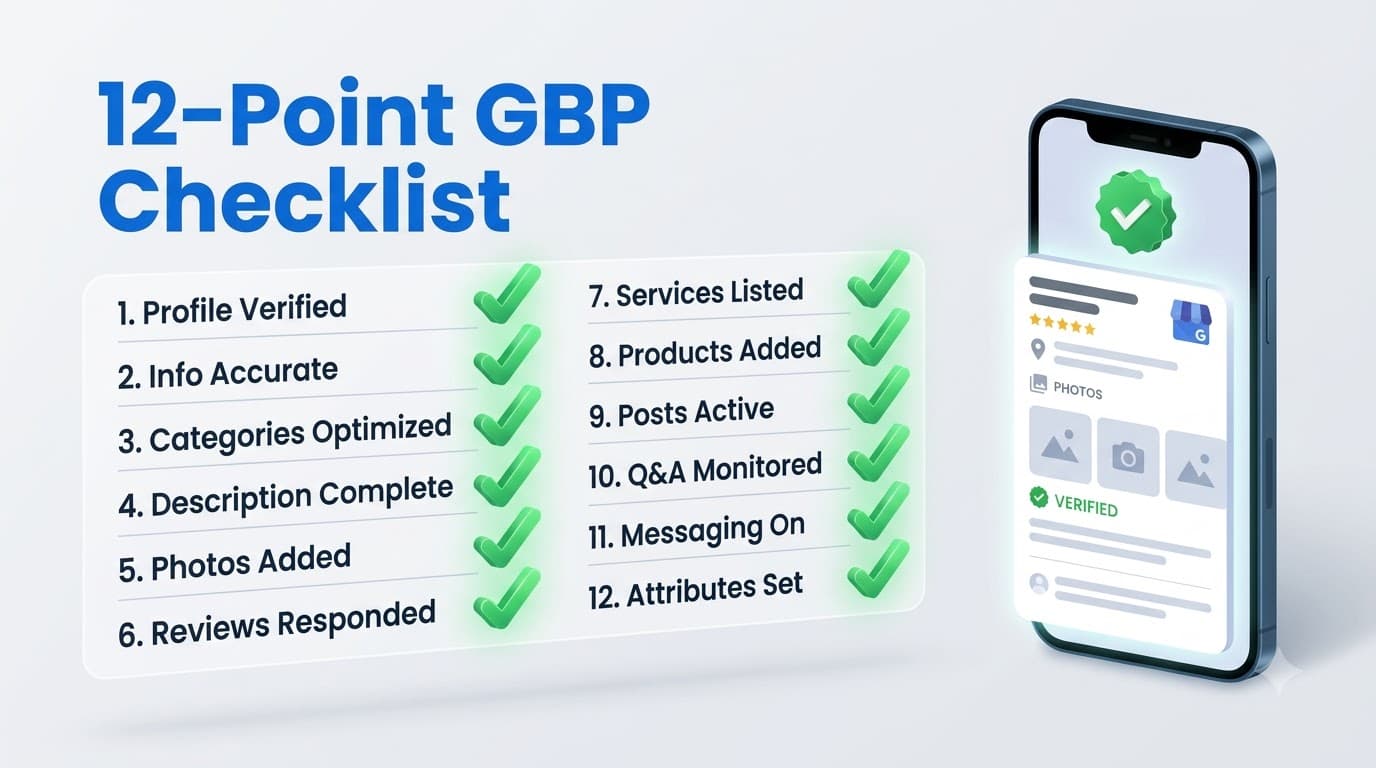
The 12-Point Google Business Profile Optimization Checklist
Complete, accurate profiles convert better and rank better — Google rewards information that helps searchers act. Yet audits routinely find profiles missing basics. Work through this checklist top to bottom; most businesses find at least four gaps. This checklist aligns with Google's Business Profile quality guidelines and pairs with geo-grid measurement to prove impact.
Treat this as quarterly maintenance, not a launch event. Profiles decay — hours drift, photos age, questions pile up. Owners who re-audit every 90 days hold rankings that one-and-done optimizers lose, as shown in multi-location scaling.
Identity & categorization
- 1. Primary category is your most specific money-category — not 'Contractor' but 'Emergency Plumber' if that's the business.
- 2. Two to four secondary categories cover adjacent services without stretching relevance.
- 3. Business name matches real-world signage exactly — no keyword stuffing; it risks suspension per GBP name policy.
Choosing categories is a relevance lever. Review plumber vertical playbook for how primary + secondary combinations map to money keywords, and use Happy Rank's category explorer if unsure.
Contact & coverage
- 4. Phone number is a local, answered line — call-tracking numbers in the profile field can fragment citation consistency.
- 5. Website link goes to the closest relevant page (location page for that branch, not always the homepage) — see local citations for NAP consistency rules.
- 6. Service-area businesses set honest coverage areas instead of hiding an address Google expects to verify. Misconfigured areas suppress visibility in adjacent neighborhoods.
After changing contact fields, re-verify NAP across Tier 1 directories (Google, Apple Maps, Bing, Yelp, Facebook) and check your Knowledge Panel for conflicting data.
Content depth
- 7. Every service listed with a one-to-two-line description — these are indexed and shown in filters.
- 8. Description uses all 750 characters wisely: who you serve, what you do, what makes you different, city mentioned naturally once.
- 9. Photos refreshed monthly: exterior helps people find you, interior builds pre-visit trust, team shots build humanity. Aim for variety over volume — see psychology of trust signals.
Service descriptions are secondary keywords. Write them for humans first, but include the natural phrasing customers use in voice search ('emergency plumber on weekends'). Add alt text to website images for accessibility and indexation.

Operations & engagement
- 10. Hours — including special hours for holidays — are always current. Wrong hours are the #1 driver of one-star 'they were closed' reviews per our negative review study.
- 11. Owner-seeded Q&A: ask and answer the six questions support hears weekly; they become permanent profile FAQ — full workflow in GBP Q&A guide.
- 12. Reviews receive a reply within a week, every time — positive and negative alike. Use AI-assisted drafts to hold 100% response velocity.
Publish weekly GBP posts to signal freshness. Posts with real photos earn 2x engagement vs text-only and keep your profile from looking abandoned during slow seasons.
“Optimization isn't a launch event. Profiles decay — hours drift, photos age, questions pile up. The winners treat this checklist as quarterly maintenance.”
Audit workflow in 30 minutes
Run this fast audit now: (1) export your profile fields into a sheet, (2) mark each of the 12 items as ✅/❌ with a link to evidence, (3) prioritize fixes by Maps impact — categories + hours + services first, then photos + Q&A. Re-scan with a geo-grid after two weeks to validate. Happy Rank syncs most fields directly from your Google account and flags what's missing, so the checklist runs itself. Connect your profile and see your scorecard in minutes.